
Continuous fiber reinforced composite materials are structural materials formed by compounding reinforcing fibers with resin and other matrices. Advanced resin composites made by combining carbon fiber with high-performance resin matrix materials are currently the most produced, stably supplied, and widely used structural composites on the market.
The resin matrix is the primary component of composite materials. Fibers are embedded inside and tightly wrapped/solidified by the matrix, which transfers and distributes loads between fibers, allowing their high-strength properties to effectively carry loads. Due to structural and property differences between thermosetting and thermoplastic resin matrices, the resulting composites exhibit distinct performance characteristics.
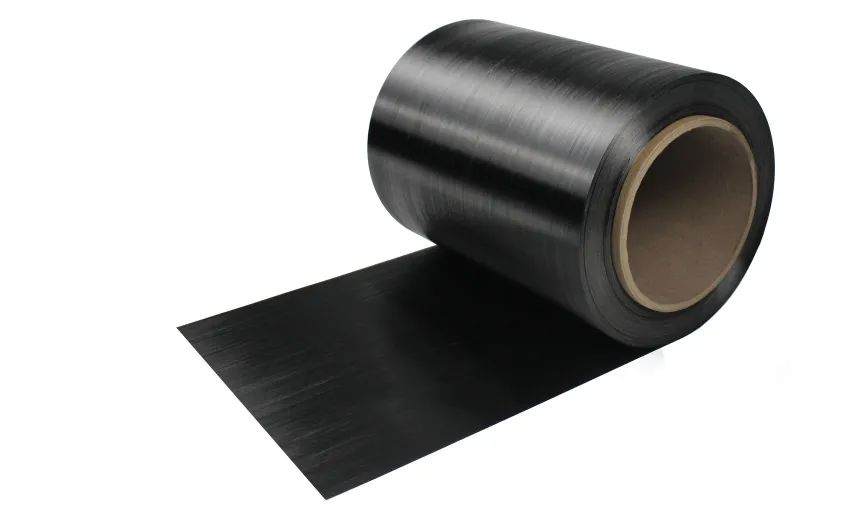
01 Material Matrix Properties and Structural Differences
1. Thermosetting Matrix Resin
Thermosetting resin is a polymer material whose molecular chains form a rigid three-dimensional cross-linked network through chemical cross-linking to provide mechanical properties. This is an irreversible curing process.
Characteristics: It features high specific strength and excellent electrical properties. Storage conditions are limited (requires low-temperature storage), the molding process is complex, and the cross-linked structure formed during polymerization cannot be reprocessed, making recycling impossible.
Modifications can improve its thermal stability, glass transition temperature ($T_g$), and storage modulus. Different formulations can significantly alter storage modulus and $T_g$. It is widely used in aerospace, marine engineering, and petrochemical industries.
Common thermosetting resins: Epoxy resin, polyester resin, phenolic resin, vinyl ester, bismaleimide (BMI), thermosetting polyimide (PI), and cyanate ester resins.
2. Thermoplastic Matrix Resin
Thermoplastic resin is a linear polymer material that can be repeatedly heat-softened and cool-hardened without undergoing chemical cross-linking. This process can be repeated without changing its molecular structure, as molecular chains rely solely on van der Waals forces or hydrogen bonds.
Characteristics: Excellent toughness, high damage tolerance, good dielectric constant, unlimited shelf life (no low-temperature storage needed), and processing without large dedicated equipment like autoclaves. Crucially, its recyclable, reusable, and eco-friendly properties align with modern environmental trends.
Common thermoplastic resins: PP, PA, PPS, PEEK, etc.
Thermosetting vs. thermoplastic selection is a fundamental design decision. Thermosetting resins are preferred for applications requiring maximum stiffness, high-temperature performance, and chemical resistance (at the cost of brittleness and poor recyclability). Thermoplastics are favored when toughness, manufacturing speed, recyclability, and repairability are prioritized.
Comparison: Conventional Thermosetting vs. Thermoplastic Resin Properties
| Performance Metric | Thermosetting Resin Matrix | Thermoplastic Resin Matrix |
| Molecular Structure | 3D Cross-linked Network | Linear / Branched |
| Processability / Recyclability | Irreversible curing, non-recyclable | Repeatable melting/molding, recyclable |
| Storage Requirement | Low temperature / Cold storage required | Room temperature storage, unlimited shelf life |
| Molding Cycle | Slow (Chemical reaction, hours) | Fast (Physical cooling, seconds to minutes) |
| Toughness & Impact Resistance | Lower (Brittle) | High toughness & High damage tolerance |
| Chemical & Moisture Resistance | Moderate to Good | Excellent (e.g., PEEK/PPS) |
3. Fiber-Matrix Interface & Interfacial Bonding
The resin-fiber interface is critical for load transfer, stress distribution, and damage tolerance. Effective interface adhesion ensures mechanical loads transfer from the weaker, ductile matrix to the strong, brittle fibers. Weak interfaces lead to premature failure via fiber pull-out, delamination, and reduced stiffness.
- Thermosetting Matrix: Demonstrates better intrinsic adhesion. Sizing agents compatible with the target resin introduce reactive chemical groups (carbonyl, hydroxyl, carboxyl) onto fiber surfaces, forming covalent or strong secondary bonds to improve wettability, interfacial shear strength, and environmental durability.
- Thermoplastic Matrix: Non-polar and chemically inert, leading to poorer fiber wettability and adhesion. Surface treatment is essential to balance stiffness, strength, and toughness.
02 Core Performance Differences
1. Fatigue & Fracture Performance
(Fracture Toughness | Impact Resistance | Damage Tolerance | Fatigue Resistance)
- Thermosetting Composites: High internal stress from 3D cross-linking lacks energy dissipation pathways under external load. This initiates and propagates matrix cracks, eventually accumulating into fracture, tearing, and delamination failure. Due to matrix brittleness, fracture toughness, impact resistance, damage tolerance, and fatigue resistance remain low.
- Thermoplastic Composites: Linear long-chain molecules undergo plastic deformation without permanent cross-links. External load energy is dissipated through chain-segment slippage, suppressing crack propagation and slowing damage accumulation. This yields superior fracture toughness, impact resistance, damage tolerance, and fatigue life.
Key Takeaway: Thermoplastics cyclically dissipate stress, passivate cracks, and reduce matrix damage accumulation, offering superior toughness and fatigue performance.
Carbon Fiber Composite Performance Comparison
| Composite System | Fracture Toughness (GIC) | Compression After Impact (CAI) | Fatigue Life |
| CF / Epoxy (Thermosetting) | Low (~0.2–0.5 $\text{kJ/m}^2$) | Low (~180–220 MPa) | Moderate |
| CF / PEEK (Thermoplastic) | High (~1.0–1.8 $\text{kJ/m}^2$) | Very High (>300 MPa) | Exceptional (Longer cycle life) |
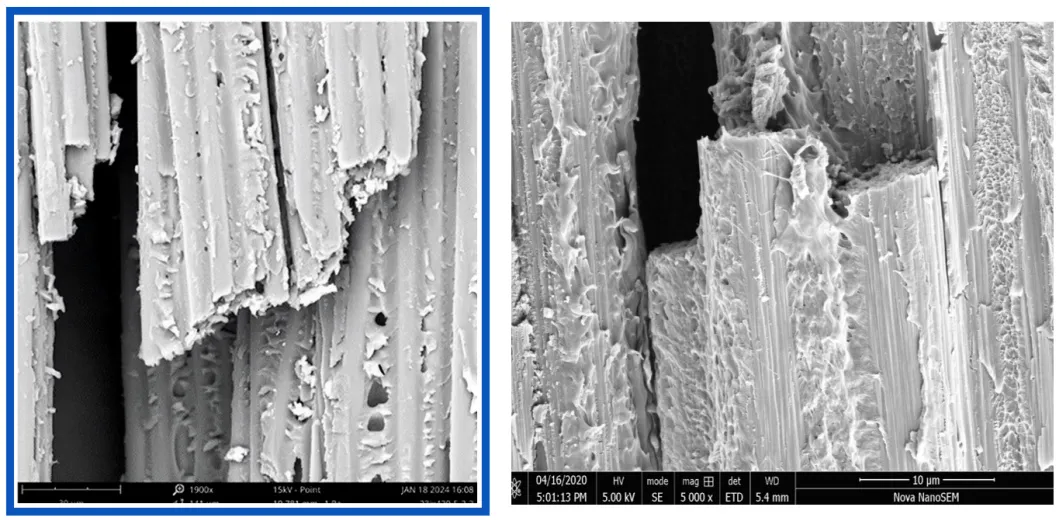
(Note: Based on SEM image observations, epoxy exhibits brittle tear-off/delamination at the interface, whereas PEEK shows ductile tear-off with minimal cracking and no delamination.)
2. Mechanical Properties
(Strength & Stiffness | Modulus)
- Thermosetting Composites: Maintains strength, stiffness, and modulus at elevated temperatures, but interlaminar performance drops once past temperature limits. Cold temperatures significantly increase brittleness and degrade mechanical properties.
- Thermoplastic Composites: Moderate high-temperature performance (drops significantly above $T_g$), but exceptional low-temperature performance.
Key Takeaway: Thermosets are preferred for static structural parts; thermoplastics are preferred for dynamic structural parts. Overall, thermoplastics offer superior comprehensive performance.
3. Thermal Performance
(Long-term Service Temp | Dimensional Stability | Thermal Processing Window)
- Long-Term Service Temperature:
- Thermosets: Epoxy (120–180°C), Phenolic (200°C); epoxy carbonizes above 380°C.
- Thermoplastics: Standard engineering resins (~150–220°C); High-end PEEK reaches up to 260°C (decomposition temp at 550°C), offering higher thermal tolerance.
- Dimensional Stability:
- Thermosets: Low coefficient of thermal expansion, highly stable dimensions.
- Thermoplastics: Handles broader/higher temp ranges, but prone to creep under high heat.
- Thermal Processing Window:
- Thermosets: Liquid/semi-fluid at room temp; lower processing temps (Epoxy at 160–180°C).
- Thermoplastics: Solid at room temp; high thermal processing temps (PEEK/TPI reach ~400°C).
4. Environmental Resistance
(Chemical Resistance | Hygrothermal Aging)
- Chemical Resistance:
- Thermosets: Susceptible to strong acids/bases, aggressive solvents, and hot oils.
- Thermoplastics: PEEK and PPS resist strong acids, strong bases, and organic solvents.
- Hygrothermal Aging:
- Thermosets: Interfacial chemical bonds easily hydrolyze and debond, causing severe drops in strength, interlaminar toughness, and fatigue performance.
- Thermoplastics: Extremely low molecular polarity makes water penetration difficult. Retains high strength, toughness, and fatigue resistance after hygrothermal aging.
5. Manufacturing & Processing Performance
(Cycle Time | Processability & Repairability | Process Compatibility)
- Cycle Time:
- Thermosets: Chemical curing reaction, time-consuming.
- Thermoplastics: Melt-cooling solidification, ideal for automated mass production.
- Repairability:
- Thermosets: Non-repairable after curing, non-recyclable.
- Thermoplastics: Repairable via thermal welding/localized remelting, fully recyclable.
- Process Compatibility:
- Thermosets: Hand lay-up, filament winding, RTM; best for large components, lower dimensional flexibility.
- Thermoplastics: Injection molding, compression molding, stamping, AFPT; best for small/precision parts, high dimensional flexibility.
Summary of Advantages & Disadvantages
Thermosetting Composites
- Advantages:
- Better dimensional stability under static loads
- Lower equipment and conventional process costs
- Lower molding temperatures and pressures
- Lower resin matrix cost
- Disadvantages:
- Lower fatigue resistance, toughness, and overall mechanical limits
- Irreversible curing; non-repairable and non-recyclable
- Long curing cycle, low efficiency
- Emits VOCs during curing, higher environmental control costs
- Requires cold storage for prepregs, high storage cost
- Severe performance decay in wet/hot environments due to hydrolysis
Thermoplastic Composites
- Advantages:
- High toughness and damage tolerance
- Thermally repairable
- Melt-recyclable, green and low-carbon
- Rapid molding speed, simple process flow
- Room-temperature storage, low logistics/warehousing costs
- High resistance to aging, chemicals, and moisture
- Disadvantages:
- Higher molding equipment costs
- Expensive resin matrices
03 Recommended Applications by Material Type
(Content from Image/Table 03)
| Thermoplastic Matrix Products | Thermosetting Matrix Products |
| New Energy Vehicle (NEV) Bumper Beams | Aircraft Main Load-bearing Fuselage & Wings |
| Battery Pack Enclosures / Housings | Wind Turbine Blades, Ship Hulls |
| Dynamic Aerospace Components | Large-scale Irregular Components |
| Drone / UAV Bodies | Static Load-bearing Structural Parts |
| Recyclable / Circular Products | |
| Assemblies Requiring Welding / Repair | |
| Long-term Acid, Alkali, or Hygrothermal Environments |
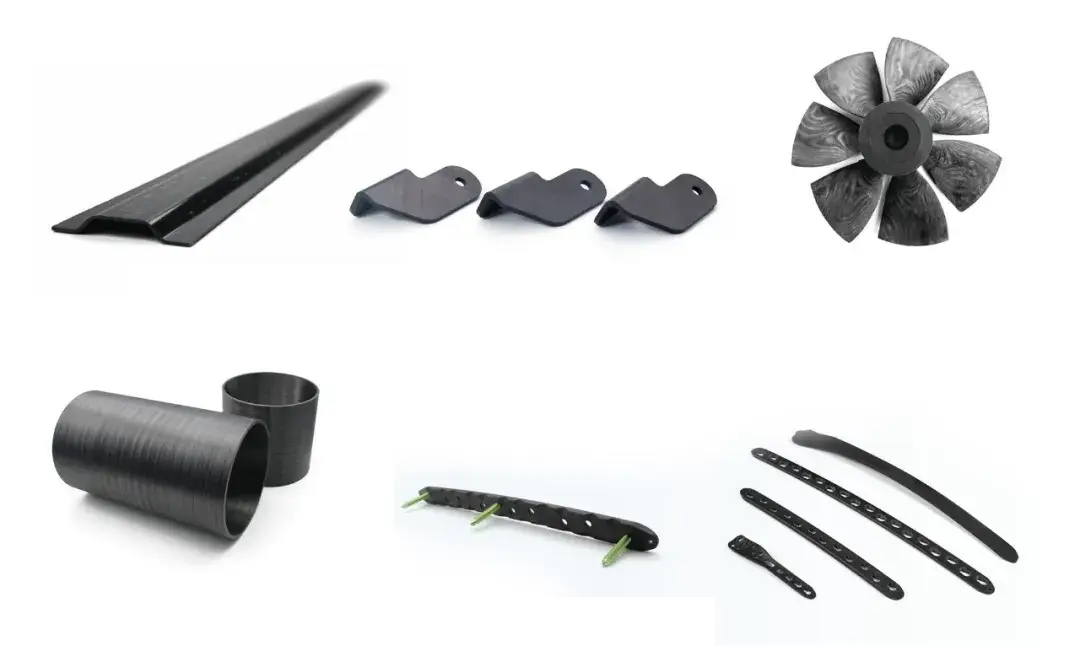
(Product Images Label Translation: CF/PEEK Bumper Beam, Aircraft Angle Brackets, CF/PEEK Marine Propeller)
04 Future Trends Summary
Thermosetting and thermoplastic composites will coexist for a long time with differentiated roles. Thermoplastics represent a forward-looking trend for high-end lightweighting and circular manufacturing, while thermosets maintain foundational markets (wind energy, marine, heavy infrastructure) due to lower cost and easy large-scale molding.
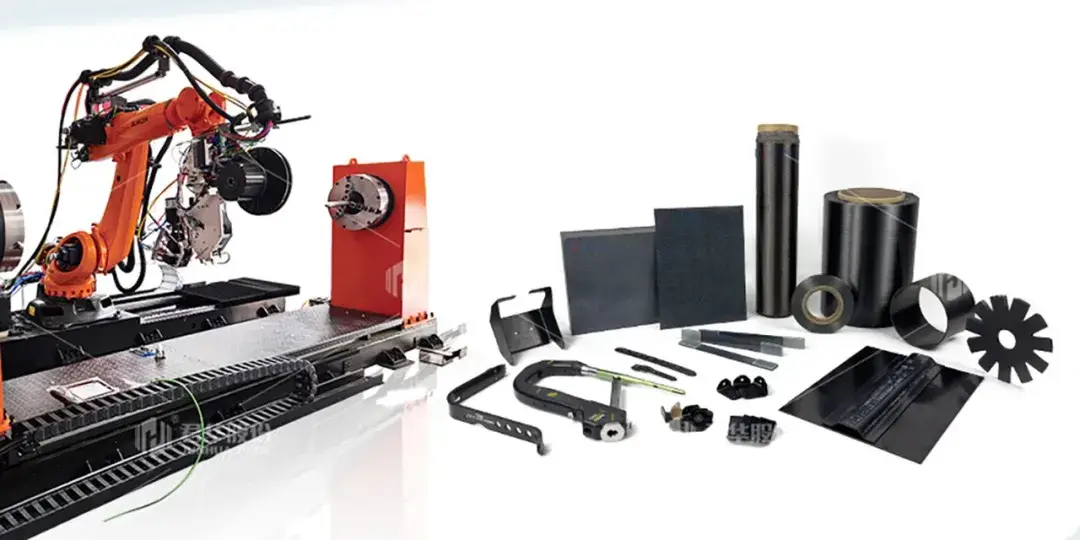
Thermoplastic composites—with inherent advantages in fatigue resistance, damage tolerance, chemical/moisture resistance, rapid thermoforming, thermal welding/repair, and melt-recyclability—perfectly fulfill the needs of next-generation equipment (NEV battery packs, high-speed rail, low-altitude aerospace vehicles) for long life, automated manufacturing, and lifecycle low-carbon impact.
Industry efforts are focused on low-cost PEEK/PPS matrices, automated fiber placement (AFP), continuous compression molding, and recycled composite processing, lowering market barriers and driving future growth.