
I. Introduction to PEEK (Polyether Ether Ketone) Cables
PEEK insulated wires, with their outstanding resistance to high and low temperatures, flame retardancy, radiation resistance, and excellent mechanical properties, can be used as ultra-high temperature wires in the aviation industry; in the petroleum industry, they can serve as winding wires and connecting wires for submersible pump motors; in nuclear power plants, they can be used as winding coils for nuclear island drive mechanisms under long-term irradiation conditions. The excellent properties of PEEK insulated wires, such as seawater resistance, light weight, small volume, and flame retardancy, make them suitable for use in ships and high-speed traction locomotives.
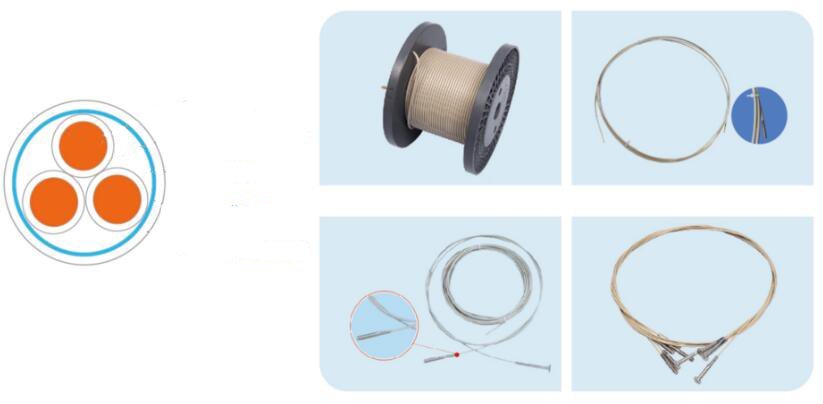
- Halogen-free PerformancePEEK material molecules do not contain halogen atoms. When burned, the material does not produce acidic gases or toxic gases, meeting environmental requirements such as the EU RoSH, and is an environmentally friendly material.
- Volume ResistanceWithin a wide temperature range, ordinary PEEK polymers can still maintain a high volume resistivity. At 23°C, the volume resistivity of PEEK is above 6 × 10¹³ Ωm; at 140°C, its volume resistivity is above 8 × 10¹² Ωm; and at 200°C, its volume resistivity is above 6 × 10⁹ Ωm, still maintaining excellent insulating properties.
- Surface ResistanceThe surface resistivity of PEEK reaches 2.0 × 10¹⁶ Ω at 25°C and 50% humidity, which is better than that of fluoroplastics, polyamides, polyimides, and other plastics.
- Dielectric Constant and Dielectric Loss FactorThe dielectric constant of PEEK5600G is only 3.2, slightly higher than that of polyethylene (PE) and fluoroplastics, but much lower than that of polyvinyl chloride (PVC). Within the frequency range of 10⁹ Hz, ordinary PEEK polymers have good electrical properties. Many electrical properties of this material conform to the typical properties of thermoplastic materials, and at the same time, PEEK polymers maintain these excellent insulating properties over an extremely wide range of temperatures and frequencies. The tan δ loss of PEEK material is small below 140°C. PPS is polyphenylene sulfide, PES is polyethersulfone, PC is polycarbonate, and PSU is bisphenol A polysulfone.
- Heat ResistancePEEK polymer has a glass transition temperature of 143°C. As a semi-crystalline thermoplastic material, it can still maintain excellent mechanical properties near its melting point of 343°C. Its fatigue resistance and creep resistance are relatively high among thermoplastic plastics.
- Flame RetardancyPEEK is self-extinguishing. Without adding flame retardants, it reaches 94V-1 (thickness 0.3 mm), 94V-0 (thickness 1.5 mm), and 94V-5 (thickness 3.2 mm) when tested according to UL standards. In addition, the amount of smoke generated during combustion is very small.
- Environmental ResistancePEEK is only soluble in concentrated sulfuric acid and has good chemical resistance, especially in terms of acid and alkali resistance at high temperatures, which is much better than that of polyimide. At the same time, the water absorption rate of PEEK is very low, with a saturated water absorption rate of only 0.5% at 23°C. Moreover, it has good hot water resistance and can be used in pressurized hot water or steam at 300°C.
- Radiation ResistanceIt has strong resistance to γ radiation, exceeding polystyrene, which has good radiation resistance among general-purpose resins. It can be made into wires that still maintain good insulating properties when the γ radiation dose reaches 850 kGy.
II. Specifications of PEEK Cables
Outer diameter 3mm, inner diameter 2.5mm; outer diameter 3mm, inner diameter 2.6mm; outer diameter 3mm, inner diameter 2mm (non-standard customization is available)
The company has introduced PEEK cable extrusion production equipment, which can extrude various specifications of PEEK cables according to customer needs. Welcome to consult and purchase!
III. Process Capabilities
- Applicable conductors: single core, composite core wire, braided core wire, and sheathed wire can also be produced;
- Applicable conductor wire diameter: 0.50mm² ~ 6.0mm² copper wire or core wire sheath extrusion, coating thickness: 0.05 ~ 0.30mm;
- Coating material: PEEK (polyether ether ketone) material, main machine extrusion capacity: approximately 28KG/H;
- Coated outer diameter: 0.75mm ~ Φ5.0mm (maximum sheath outer diameter: Φ6.0mm);
- Flat magnet wire (reserved function): 3.30mm * 11.40mm (within the range of 2.0mm * 12.0mm), coating thickness: 0.20 ~ 0.70mm;
FAQ of PEEK Cables
A: The core advantages of PEEK cables include resistance to high and low temperatures, halogen-free environmental protection and flame retardancy, super insulation, radiation resistance, chemical corrosion resistance, as well as light weight and low water absorption. It has a glass transition temperature of 143℃ and a melting point of 343℃, is halogen-free and produces no acidic or toxic gases when burned, complying with EU RoSH. It maintains high volume and surface resistivity over a wide temperature range, still retains insulation performance at a γ radiation dose of 850 kGy, is only soluble in concentrated sulfuric acid, and has a saturated water absorption rate of only 0.5% at 23℃.
A: Relying on excellent all-round performance, PEEK cables can be used as ultra-high temperature wires in the aviation industry, winding wires and connecting wires for submersible pump motors in the petroleum industry, and winding coils for nuclear island drive mechanisms under long-term irradiation conditions in the nuclear power industry. They are also suitable for ships, high-speed traction locomotives and other scenarios that require seawater resistance, light weight and flame retardancy.
A: PEEK cables maintain excellent insulation performance over a wide temperature range, with a volume resistivity of ≥6×10¹³ Ωm at 23℃, ≥8×10¹² Ωm at 140℃, and still ≥6×10⁹ Ωm at a high temperature of 200℃. The surface resistivity reaches 2.0×10¹⁶ Ω at 25℃ and 50% humidity.
A: The conventional specification of PEEK cables is an outer diameter of 3mm, with three matching inner diameters: 2.5mm, 2.6mm and 2mm. At the same time, full-dimensional non-standard customization is supported, and PEEK cables with different inner and outer diameters can be extruded according to customers’ actual needs.
A: Our company has a complete extrusion production capacity for PEEK cables, with the core process parameters as follows: suitable for 0.50mm²~6.0mm² copper wires/core wires, with a coating thickness of 0.05~0.30mm; the main machine extrusion capacity of PEEK material is about 28KG/H; the coating outer diameter ranges from 0.75mm to Φ5.0mm, with a maximum sheath outer diameter of Φ6.0mm; single-core, composite-core, braided-core wires and sheathed wires can be produced. Flat magnet wires are suitable for specifications within 2.0mm×12.0mm, the conventional one is 3.30mm×11.40mm, with a coating thickness of 0.20~0.70mm.
A: PEEK material has self-extinguishing properties by itself without adding any flame retardants. Tested according to UL standards, it reaches 94V-1 with a thickness of 0.3mm, 94V-0 with a thickness of 1.5mm, and 94V-5 with a thickness of 3.2mm, with extremely low smoke emission during combustion.
A: The electrical performance of PEEK cables is superior to traditional plastic cables such as PVC, fluoroplastics and polyimides: the dielectric constant of PEEK5600G is only 3.2, much lower than PVC and slightly higher than PE and fluoroplastics; the surface resistivity is better, and the electrical performance has no obvious attenuation in the frequency range of 10⁹ Hz and an extremely wide temperature range, with a small tan δ loss below 140℃.
A: PEEK cables have excellent environmental resistance, being only soluble in concentrated sulfuric acid, and their acid and alkali resistance at high temperatures is much better than that of polyimides. It has low water absorption and hot water resistance, with a saturated water absorption rate of 0.5% at 23℃, can be used in 300℃ pressurized hot water or steam environment, and also has excellent seawater resistance.